
What Causes Slate Roof Damage in the UK? Common Factors Explained
admin2026-08-24T04:46:39+00:00
Causes Of Slate Roof Damage Uk
Slate roof damage in the UK often becomes visible as a slipped slate, a small leak, or a patch of broken material, but the visible defect is not always the real cause. Corroded fixings, weakened battens, wind uplift, persistent moisture, poor workmanship, and failed roof details can all create problems behind apparently durable slate.
Real UK homeowner discussions show that repeated slipping and previous patch repairs often raise the biggest concern: is the problem isolated, or is something underneath starting to fail? The right approach is to identify why the slate moved or broke before deciding how much work is actually required.
Quick Check: Before appointing a provider, arrange a roof inspection that checks slate fixings, hidden timber condition, and signs of water ingress before recommending repair work.
Slate Roof Damage in the UK: Weather Causes
Weather can expose weaknesses that have been developing for years. Wind, driving rain, frost, persistent damp, and biological growth do not affect every slate roof equally, but they can accelerate failure when fixings, materials, or drainage are already vulnerable.
Main Slate Damage Factors at a Glance
Damage Factor | Real-World Signal | What It Can Affect | Priority |
Nail sickness | Highest-engagement Reddit comment received 487 upvotes | Slate fixings and repeated slipping | Very High |
Multiple loose slates | 140-upvote homeowner response | Wider fixing or support failure | Very High |
Failed battens/fixing points | 34-upvote response | Support beneath the slate | High |
Storm exposure | Homeowner reported losing 1–2 slates during storms | Slates and weakened fixings | High |
Freeze-thaw cycles | Supported by UK conservation guidance | Slate edges and layers | Medium/High |
Heavy moss and poor drainage | Supported by roof-maintenance guidance | Moisture retention and drainage | Medium |
Wind Uplift Can Dislodge Weak Slates
Strong wind does not necessarily mean a sound slate suddenly fails for no reason. Wind pressure can exploit loose fixings, weakened slate edges, previous repairs, or gaps where movement has already started.
Homeowners who repeatedly lose slates during bad weather should look beyond the individual missing piece. The pattern may indicate deteriorating fixings or another weakness that storms are exposing.
Checking for post-storm roof inspection warning signs can help identify newly slipped, cracked, or missing pieces before another period of heavy rain increases the risk of water ingress.
The wider roof materials suited to British weather also matter because different coverings respond differently to wind, frost, rain, and changing temperatures.
Freeze-Thaw Cycles Can Weaken Slate
Natural slate is durable, but damaged or poor-quality slate can still develop cracks, flaking, or delamination, where thin layers begin separating.
Repeated wetting followed by freezing can place additional stress on existing fissures. This does not mean every cold winter damages slate, but vulnerable material can deteriorate faster where moisture repeatedly enters small defects.
A useful inspection looks for splitting edges, thin flakes separating from the slate, powdering, or repeated cracking in the same roof area rather than assuming frost is responsible for every break.
Persistent Water Makes Small Defects Worse
Water often becomes most damaging when another defect has already created a path into the roof.
A slipped slate, cracked flashing, open joint, failed valley detail, or damaged roof window can allow moisture to reach battens and other timber components. If the defect remains unresolved, a small exterior problem may develop into a larger hidden one.
This is why a proper inspection should assess both the visible slate covering and signs that water may have travelled behind it.
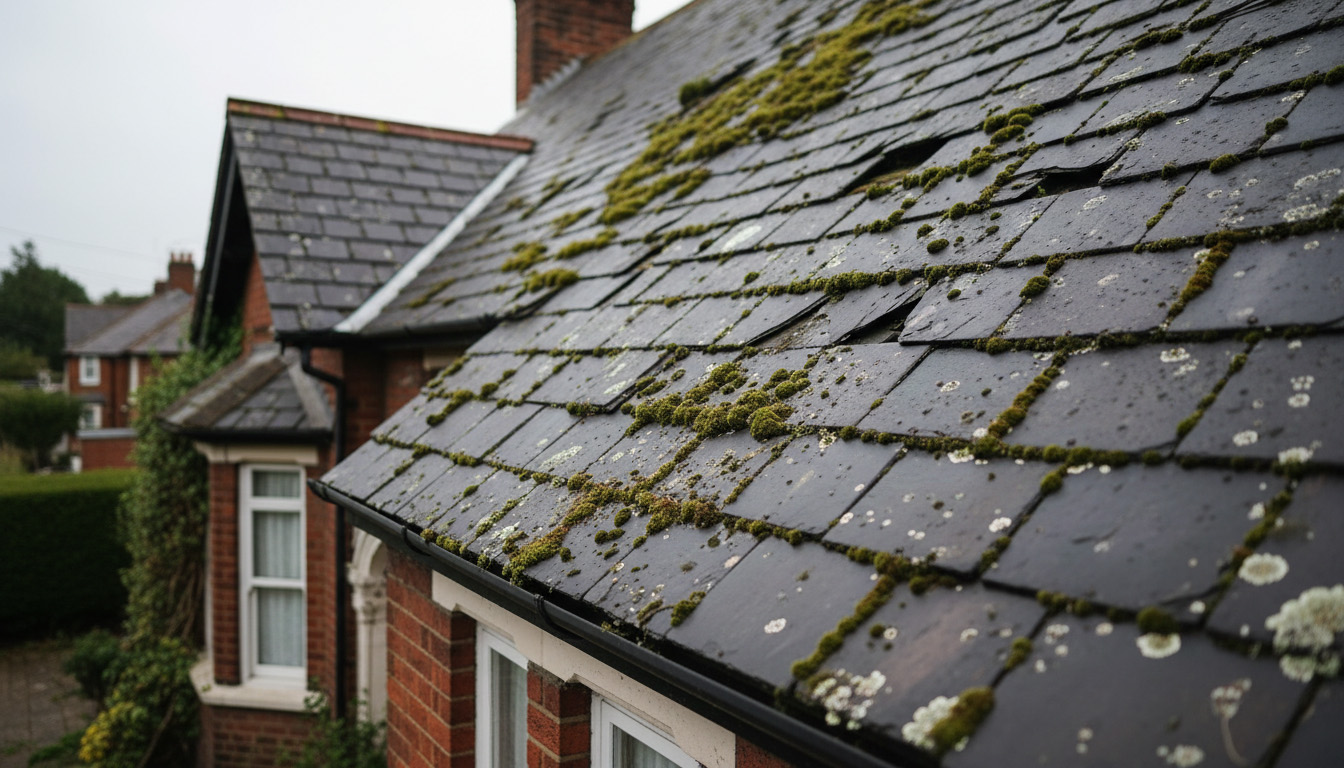
Moss Is a Contributing Factor, Not Proof of Failure
Moss is often blamed for any ageing slate roof, but visible moss does not automatically mean the slate has failed.
Heavy growth can retain moisture and may interfere with gutters or drainage routes. That makes it relevant to maintenance, especially on shaded or damp roof slopes, but the underlying slate condition still needs to be judged separately.
Understanding conditions that encourage roof moss growth is more useful than assuming every green roof requires aggressive treatment.
Ignoring proper methods for cleaning slate roofs can create damage if fragile slates are walked on or forceful cleaning disturbs weak fixings.
Slate Roof Damage in the UK: Ageing Failures
Many older slate roofs fail because the parts holding the slate in place deteriorate before the slate itself. Corroded nails, decaying battens, worn fixing holes, ageing flashings, and previous repairs can gradually turn a stable covering into one that repeatedly slips.
Nail Sickness Is a Major Warning Sign
One of the clearest real-world concerns is nail sickness, the gradual corrosion or failure of old slate fixings.
In the supplied homeowner discussion, the highest-engagement response received 487 upvotes and linked numerous slipped or previously refixed slates with deteriorating nails. That does not mean one missing slate proves widespread nail sickness, but repeated failures deserve a closer inspection.
When nails weaken, intact slates can begin sliding down the roof even though the stone itself remains usable.
The expected factors affecting natural slate longevity therefore depend on more than the slate. Fixings, battens, workmanship, exposure, and maintenance history all influence how long the roof remains reliable.
Repeated Slipping Can Signal a Wider Problem
One isolated slipped slate can often be repaired. Several slipping slates, especially across the same slope, tell a different story.
The supplied Reddit discussion included a 140-upvote response highlighting numerous loose slates and exposed timber. Another 34-upvote response raised the possibility of deteriorated battens and worn fixing points.
Warning Signs Behind Visible Slate Damage
Visible Sign | Possible Underlying Cause | What Should Be Checked |
One isolated slipped slate | Local fixing failure | Slate, nail or hook, surrounding pieces |
Several slipped slates | Nail sickness or support deterioration | Fixings, battens, wider roof slope |
Slate falls intact | Fixing may have failed before slate | Nails, nail holes, battens |
Exposed timber | Long-standing opening or displaced covering | Battens, rafters, moisture damage |
Repeated patch repairs | Underlying cause not resolved | Whole affected area |
Sagging roof line | Possible support or structural movement | Timbers and roof structure |
Damp near chimney or valley | Flashing or junction problem | Leadwork and surrounding details |
The important lesson is simple: do not judge the condition of the whole roof from one visible slate.
Where the roof line itself appears distorted, reviewing reasons a roof structure starts sagging can help distinguish a surface-covering issue from a deeper structural concern.
Battens Can Fail Behind Sound Slate
Slate may remain physically sound while the timber supporting it deteriorates.
Battens can weaken through prolonged moisture exposure, fungal decay, age, or earlier water ingress. Once support or fixing points become unreliable, more slates may begin slipping even if replacing one piece initially appears to solve the problem.
This is why repeated slate movement should lead to inspection of what the slate is fixed to, not just repeated replacement of what has fallen.
If damage has progressed beyond isolated repairs, roof restoration after damage may be considered only after the actual extent of deterioration is established.
Water Ingress Can Damage Hidden Timber

Slate damage becomes more serious when water passes through the covering and remains unnoticed.
Battens, rafters, boarding, insulation, ceilings, and internal finishes can all be affected depending on where moisture travels. The damage seen from outside may therefore underestimate what has happened underneath.
A homeowner in the supplied discussion described a roof that had been losing one or two slates during storms. Once the covering was removed, severely deteriorated old iron nails became visible.
That experience supports an important rule: repeated slate loss deserves diagnosis, not endless patching.
Flashing and Roof Junctions Can Mimic Slate Failure
Not every leak on a slate roof is caused by broken slate.
Lead flashings around chimneys, valleys, ridges, roof windows, and adjoining walls can fail independently. Water entering through those junctions may make the surrounding slate appear responsible even though the defect lies elsewhere.
Where the property uses several roof coverings, understanding the differences between tile slate and flat roofs can help separate maintenance requirements for each section.
If a flat-roof extension is also deteriorating, flat roof replacement london should be assessed as a separate roofing need rather than applying slate-roof assumptions to that section.
Age Alone Does Not Decide Roof Condition
Older slate is not automatically unusable.
Many pieces can remain serviceable even when their original fixing system has deteriorated. The real decision is whether failures are isolated and repairable or widespread enough that repeated patching no longer makes practical sense.
Understanding roof covering durability and lifespan differences provides useful context, but actual roof condition should always carry more weight than a generic age estimate.
Slate Roof Damage in the UK: Human Errors
Some slate failures are created or accelerated by poor installation, inappropriate repairs, careless foot traffic, badly fitted penetrations, or incorrect replacement materials. These causes matter because they can damage an otherwise serviceable roof and leave recurring problems behind.
Poor Workmanship Can Create Repeat Failures
The supplied homeowner discussion included examples of slates that had been siliconed, mortared, wedged, or temporarily patched rather than properly dealt with.
That matters because a visible repair may hide the original fault. If the slate failed because the fixing, batten, flashing, or surrounding detail was defective, simply holding the same piece back in position may not solve the cause.
One of the strongest homeowner observations was essentially: do not only ask what broke; ask why it broke.
That should guide every diagnosis of recurring slate damage.
Incorrect Fixing Can Damage Good Slate
Fixings need to hold slate securely without creating unnecessary stress.
Poor nail placement, oversized holes, incorrect overlap, unsuitable replacement pieces, or fastening methods that restrict natural movement may contribute to future cracking or slipping.
If damaged sections require roof tile replacement, the work should account for material compatibility, fixing method, and the condition of the surrounding roof rather than treating each damaged piece in isolation.
The wider roof tile selection considerations are also relevant where existing slate needs to be matched with an appropriate replacement.
Understanding the common roofing tile varieties in Britain helps avoid treating slate, concrete, clay, and other coverings as though they have identical fixing and maintenance requirements.
Foot Traffic Can Crack Vulnerable Slate
Slate roofs should not be treated like ordinary walking surfaces.
Concentrated weight can crack individual slates, particularly older pieces or those already weakened around fixings. People walking across the roof for gutter work, aerial installation, chimney repairs, cleaning, or unrelated maintenance can therefore create damage that did not previously exist.
Safe access should be planned before any work begins.
Any slate roof repair london work should minimise unnecessary movement across the roof and pay close attention to fragile or previously repaired areas.
Roof Windows and Penetrations Need Correct Detailing
Roof windows can become local trouble spots when their surrounding slate and flashing details are poorly installed.
In the supplied homeowner discussion, several participants questioned an unusual roof-window and valley arrangement because the surrounding roof showed wider signs of deterioration.
The lesson is not that roof windows automatically damage slate. It is that every penetration interrupts the normal water-shedding pattern, so poor detailing around it can create a local leak.
Different Roof Sections Need Different Maintenance
A property may contain slate on the main pitch, tile on an extension, and a flat covering elsewhere.
These areas should not be maintained as if they are the same system. Where the pitched section is damaged, pitched roof repair london work focuses on different failure points from flat-roof work, especially around fixings, overlaps, ridges, and valleys.
Comparing roofing materials can also help explain why exposure, material type, and roof form change the pattern of deterioration.
Repeated Repairs Need a Root-Cause Decision
A slate roof that needs one isolated repair is not the same as a roof that loses slates after every storm.
Repeated patching becomes a warning sign when:
- several areas have already been refixed,
- new slates continue to slip,
- old repairs repeatedly fail,
- battens or fixings appear weak,
- water has reached internal timber,
- or roof movement is becoming visible.
At that stage, the decision should be based on extent and cause, not on a fixed percentage or an assumption that every old slate roof must be completely replaced.
For mixed-material properties, differences between roof systems can also help explain why individual sections may reach repair thresholds at different times.
Slate Roof Damage in the UK: Act on the Cause
A slipped or cracked slate is useful evidence, but it is only the starting point. Repeated failures deserve a wider check of fixings, battens, water entry points, previous repairs, and the surrounding roof.
A sound inspection should explain why the damage occurred, whether it is isolated, and whether surrounding materials remain serviceable. That is more useful than automatically recommending either another temporary patch or a complete reroof.
Slate Roof Damage in the UK: FAQs
Does one slipped slate mean the whole slate roof is failing?
No. One slipped slate does not automatically mean slate roof damage in the UK has become a whole-roof failure. An individual fixing can fail locally while surrounding slates and battens remain sound. Concern increases when several slates are slipping, previous repairs are widespread, or the same roof slope repeatedly loses material. Those patterns justify checking the wider fixing system and support beneath the covering.
Can old slate be reused after the fixings have failed?
Potentially, yes. Slate roof damage in the UK can sometimes be caused mainly by failed nails or battens while individual natural slates remain usable. Each piece needs to be assessed for cracking, delamination, damaged fixing holes, and general condition before reuse. The condition of the slate should be judged separately from the condition of the original fixing system.
How can nail sickness be spotted before many slates fall?
Early slate roof damage in the UK linked to nail sickness may appear as isolated slates beginning to move, an increasing number of slipped pieces, or repeated refixing across the same slope. Intact slates sliding downward can be particularly relevant because the slate itself may not have broken. A wider inspection is needed before concluding that nail corrosion is affecting the whole roof.
Can failed chimney flashing look like slate damage?
Yes. Some apparent slate roof damage in the UK is actually water entering around lead flashings, chimney abutments, valleys, or other junctions. Damp appearing below a slate roof does not prove the slate itself is defective. The location of staining, nearby roof details, and the condition of flashings should be checked before surrounding slate is unnecessarily replaced.
Can a badly installed roof window cause slate leaks?
Yes. A roof window interrupts the normal drainage pattern of the slate covering, so poor detailing can contribute to slate roof damage in the UK or allow water to enter around otherwise sound slates. Problems may involve flashing, incorrect slate arrangement, gaps, or nearby valley details. The whole window junction should be inspected rather than repeatedly replacing individual slates around it.
Does moss actually cause slate roof damage?
Heavy moss can contribute to conditions associated with slate roof damage in the UK by retaining moisture and interfering with drainage, but moss alone does not prove slate failure. A green or mossy roof may still contain serviceable slate. The important checks are whether growth is obstructing gutters, trapping persistent moisture, hiding defects, or encouraging unsafe cleaning methods that could damage fragile pieces.
When should slate damage be repaired instead of reroofed?
The decision depends on the extent and underlying cause of slate roof damage in the UK. A few isolated broken or slipped slates may justify targeted repair when surrounding fixings and support remain sound. Wider renewal becomes more reasonable when slipping is widespread, battens or nails are deteriorating across large areas, repeated patches keep failing, or water ingress has caused broader hidden damage.
Comment (1)
[…] the causes of slate roof damage helps separate a simple cleaning problem from a roof defect. Moss is visible; failing fixings or a […]
Comments are closed.