
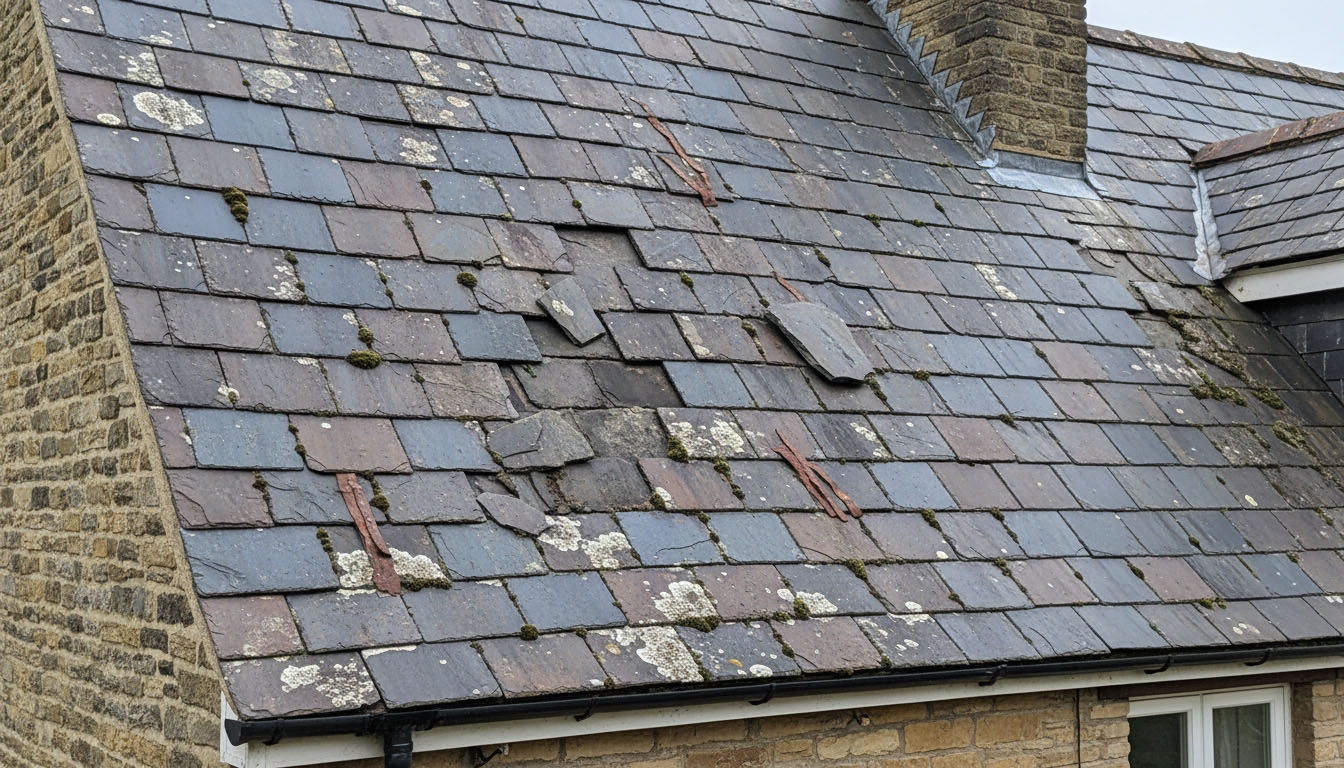
Common Slate Roof Problems UK can include slipped slates, cracked slate edges, missing slates, failed fixings, leaking chimneys, damaged leadwork, blocked valleys, moss build-up, gutter overflow, sagging rooflines, storm damage, damp loft timbers, and previous repairs that no longer hold.
A&A Roofing London helps homeowners across London, Essex, and the Hertfordshire borders identify slate roof problems before they spread into underlay, battens, insulation, ceilings, and structural timbers. The goal is to inspect the roof properly, trace the cause of the defect, and decide whether the roof needs maintenance, repair, restoration, or replacement.
Quick Check: If you can see slipped slates, ceiling stains, chimney damp, moss build-up, valley blockage, or roofline movement, ask A&A Roofing London to arrange a roof inspection in the UK before the problem reaches hidden roof layers.
Common Slate Roof Problems UK: Main Warning Signs
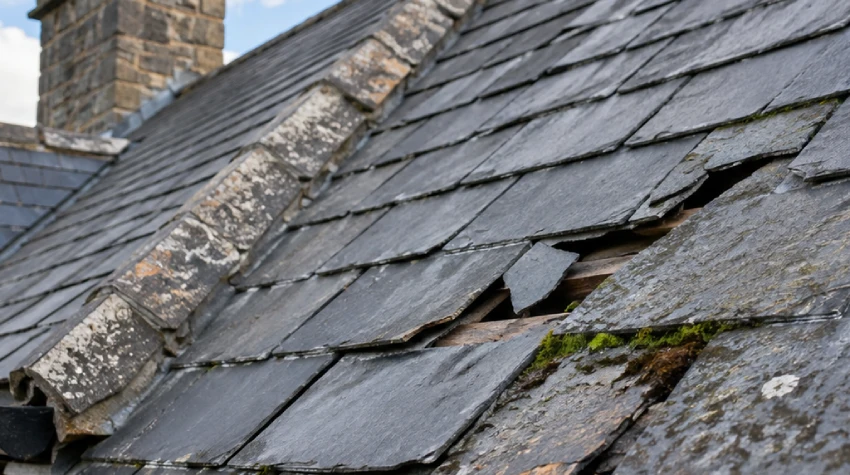
Common Slate Roof Problems UK should be checked as part of the full roof system. Slate problems often appear on the surface, but the cause may be in the fixings, battens, underlay, leadwork, chimneys, valleys, gutters, ventilation, or previous repair work.
| Problem | What it may mean | What A&A Roofing London checks |
| Slipped slates | Fixing failure, wind movement, weak battens, or ageing slate | Slate position, fixings, battens, nearby courses |
| Cracked slates | Impact, frost, poor access, foot traffic, or material age | Crack pattern, edges, repair history |
| Missing slates | Storm damage, failed fixings, or loose roof edges | Exposed underlay, roof slope, verges |
| Chimney damp | Failed flashing, pointing defects, or stack issues | Leadwork, chimney stack, nearby slate |
| Blocked valleys | Moss, leaves, silt, or broken slate pieces | Valley lining, water flow, adjacent slates |
| Gutter overflow | Blocked outlets or poor rainwater discharge | Gutters, downpipes, eaves, lower roof edges |
| Moss build-up | Moisture retention and blocked drainage risk | Valleys, gutters, outlets, slate surface |
| Loft damp | Water entry, condensation, or underlay failure | Insulation, timbers, airflow, stain pattern |
| Sagging roofline | Structural movement or support failure | Rafters, ridge line, roof spread, loading |
| Failed repair patches | Previous work did not solve the cause | Patch quality, repeated leaks, surrounding details |
A&A Roofing London checks the visible problem and the roof details around it. A cracked slate may be simple to replace, but the same crack beside a blocked valley, lifted flashing, or damp loft space may need deeper investigation.
What Are the Most Common Slate Roof Problems in the UK?
The most common slate roof problems are slipped slates, cracked slates, loose fixings, chimney leaks, failed flashing, blocked valleys, moss build-up, gutter overflow, storm movement, and recurring leaks after poor repairs.
A&A Roofing London checks whether the problem is local or part of a wider pattern. One damaged slate may be a repair job. Several defects across different slopes may suggest ageing fixings, hidden underlay failure, weak battens, poor workmanship, or weather-related deterioration.
For root-cause context, slate damage origin markers are useful.
Slipped Slates
Slipped slates are one of the clearest visible problems on a slate roof. A slate can slip when fixings corrode, nail holes fail, battens weaken, wind lifts the covering, or previous repairs were not secured correctly.
A&A Roofing London checks whether the slipped slate is isolated. If slates are slipping in several places, the roof may have a fixing or batten issue rather than a single loose unit.
A slipped slate should not be ignored because it can expose the underlay and allow wind-driven rain beneath the surrounding slate courses.
Cracked or Broken Slates
Cracked or broken slates can let water enter beneath the roof covering. Cracks may come from impact, frost, foot traffic, poor cleaning, weak material, bad handling, or old repairs.
A&A Roofing London checks whether the cracked slate can be replaced locally or whether similar cracks appear across the roof. Repeated cracking can suggest material deterioration, poor access history, or wider roof ageing.
For defect review, slate defect cause groups can help separate accidental damage from deeper roof problems.
Missing Slates After Storms
Missing slates often appear after strong wind or storms. The missing slate may be the visible problem, but the cause can include weak fixings, exposed roof edges, old battens, loose ridge areas, or poor previous repair work.
A&A Roofing London checks the missing slate area, surrounding slates, roof edges, ridges, gutters, valleys, and any broken pieces found below. Storm damage should be assessed before a simple patch is assumed.
For storm checks, storm-damage roof review sequence and urgent storm roof response steps are useful.
Slate Roof Leaks
Slate roof leaks can be difficult to trace because water may travel before it appears indoors. A damp ceiling mark may come from a slipped slate, failed flashing, blocked valley, chimney defect, gutter overflow, or underlay failure.
A&A Roofing London checks internal stains, loft damp, wet insulation, roof features above the leak, and nearby water routes. The repair should target the entry point, not just the area directly above the ceiling stain.
For leak tracing, roof leak pathway clues are relevant.
Chimney Leaks on Slate Roofs
Chimneys are common leak points on slate roofs. Water can enter through failed lead flashing, cracked pointing, open lead chases, damaged chimney stacks, poor soakers, or gaps beside nearby slates.
A&A Roofing London checks chimney stacks, lead aprons, soakers, flashing, mortar, nearby slate edges, loft damp, and staining around the chimney breast.
For chimney-related roof leaks, chimney leak evidence points are useful.
Leadwork and Flashing Problems
Leadwork protects roof junctions where slate meets chimneys, walls, dormers, valleys, or abutments. If leadwork lifts, splits, opens, or has been patched poorly, water can enter even when the surrounding slates are in good condition.
A&A Roofing London checks flashings, soakers, aprons, chases, overlaps, and previous sealant patches. Poor leadwork repairs can create repeated leaks that are wrongly blamed on the slate surface.
For detail diagnosis, flashing defect location notes and leadwork junction inspection notes are useful.
Valley Blockages and Valley Leaks
Roof valleys collect water from two slopes, so they carry more rainwater than many other roof details. Moss, leaves, silt, broken slate pieces, and debris can block the valley and force water under nearby slates.
A&A Roofing London checks valley lining, adjacent slate edges, debris, damp below the valley route, and previous repair work. A valley leak can spread quickly because water is concentrated in one channel.
For valley problems, valley leak pattern notes are useful.
Moss Build-Up on Slate Roofs
Moss is not always a structural problem, but it becomes important when it blocks gutters, valleys, outlets, and roof edges. Moss can also hide cracked slates or hold debris against roof details.
A&A Roofing London checks whether moss is affecting drainage before recommending cleaning or removal. The aim is to protect water flow without damaging the slate surface.
For moss-related roof care, moss growth condition review and moss removal drainage notes are useful.
Gutter Overflow and Slate Roof Damage
Gutter overflow can affect slate roofs by pushing water back toward the eaves, fascia, walls, and lower roof edges. Blocked gutters can also hide broken slate pieces, moss, and debris from the roof above.
A&A Roofing London checks gutters, outlets, downpipes, eaves, roof edges, valley outlets, and staining below overflow points. If water cannot leave the roof cleanly, the slate roof may deteriorate faster around the edges.
Overflow should be checked alongside the slate condition, not treated as a separate issue.
Sagging Roofline or Roof Movement
A sagging roofline is one of the more serious slate roof problems. It can indicate timber movement, roof spread, long-term loading, water-damaged structure, or previous work that changed how the roof carries weight.
A&A Roofing London checks the ridge line, rafters, roof shape, ceiling level, loft timbers, and signs of damp. Local slate repair may not be enough if the support below the slate has moved.
For this issue, roofline movement risk notes are relevant.
Problems Caused by Walking on Slate
Walking on a slate roof can crack slates, loosen fixings, shift courses, disturb leadwork, and create hidden leak paths. Some damage is visible immediately, while other damage appears later as damp, slipped slate, or repeated leaks.
A&A Roofing London advises homeowners not to walk on slate roofs. Inspections should be carried out using safer methods and suitable access.
For access safety, slate roof access risk notes are useful.
Cleaning Damage on Slate Roofs
Cleaning damage can happen when slate is pressure washed, scraped aggressively, walked on unnecessarily, or treated with unsuitable methods. Poor cleaning can crack slate, disturb fixings, lift edges, or force water into weak roof details.
A&A Roofing London checks whether cleaning is needed for drainage rather than appearance alone. If moss or debris is blocking water flow, cleaning should be controlled and roof-safe.
For cleaning decisions, slate cleaning caution points are useful.
Weather Damage on Slate Roofs
Rain, wind, frost, moss, and seasonal debris can all expose slate roof problems. Rain tests laps, leadwork, valleys, and gutters. Wind can lift loose slates. Frost can worsen cracks and damp chimney areas. Storms can reveal weak fixings and poor repairs.
A&A Roofing London checks slate roof condition after weather events when new leaks, missing slates, broken fragments, or gutter overflow appear.
For weather-related roof issues, weather damage route markers are useful.
When Do Slate Roof Problems Need Repair?
Slate roof problems need repair when a defect is allowing water entry, exposing underlay, affecting drainage, moving under wind, or recurring after previous maintenance. Repair may involve replacing slates, correcting fixings, repairing flashing, clearing valleys, or addressing chimney leaks.
A&A Roofing London checks whether the repair should be local or whether surrounding roof details also need attention.
For repair planning, slate correction decision notes and roof defect action signals are useful.
When Do Slate Roof Problems Mean Replacement?
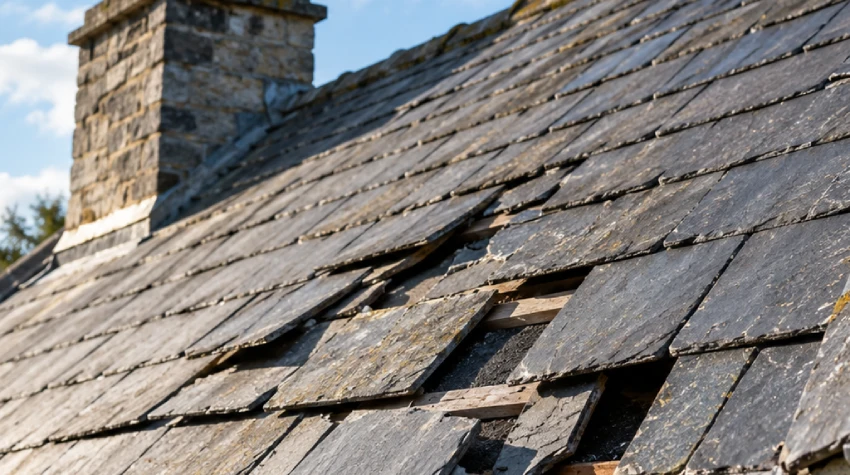
Slate roof problems may mean replacement when defects are widespread, leaks keep returning, underlay has failed, battens are weak, fixings are unreliable, the roofline has moved, or repeated repairs no longer hold.
A&A Roofing London checks whether repair, restoration, or replacement is the right route. Replacement should be based on the roof system’s condition, not one surface defect.
For replacement planning, slate renewal evidence checklist and repair replacement comparison guide are useful.
Inspection for Slate Roof Problems
A proper inspection should review slate condition, fixings, battens, underlay signs, leadwork, chimneys, valleys, gutters, ridges, roof edges, loft damp, roofline movement, moss, weather exposure, and previous repairs.
A&A Roofing London uses inspection to locate the cause of the problem. This helps prevent repeated patching where the visible slate is only part of the issue.
For inspection planning, slate inspection timing clues, roof inspection schedule factors, and roof condition checklist notes are useful.
Maintenance to Prevent Slate Problems
Maintenance helps prevent small slate roof problems from becoming leaks or replacement-level damage. Key maintenance checks include gutter clearing, valley review, moss control, leadwork inspection, chimney checks, slipped slate replacement, and loft damp monitoring.
A&A Roofing London checks maintenance needs based on roof age, weather exposure, trees, repair history, and visible condition.
For maintenance planning, slate maintenance task structure, slate upkeep condition notes, and preventive roof care sequence are useful.
Lifespan and Slate Roof Problems
Slate roof lifespan depends on material quality, pitch, fixings, battens, underlay, leadwork, weather exposure, drainage, ventilation, and maintenance. Roof problems increase when the surface material, support layers, and water-control details start failing together.
A&A Roofing London checks whether problems match normal ageing or signal wider failure. A roof with sound slate and local damage may be repairable. A roof with repeated slips, leaks, and hidden damp may need deeper work.
For lifespan context, slate lifespan defect factors and slate ageing problem stages are useful.
Roof Tile Replacement Compared With Slate Problems
Roof tile replacement in London differs from slate work because tiles and slates fail in different ways. Tile roofs may show cracked tiles, displaced ridge pieces, broken corners, and tile fragments in gutters. Slate roofs often show slipped slates, cracked edges, fixing failure, and matching issues.
A&A Roofing London checks tile and slate areas separately, especially on homes with mixed roof materials. The repair method should match the covering, pitch, structure, and drainage route.
Flat Roof Replacement Near Slate Roof Problems
Flat roof replacement in London may become relevant when a slate roof drains onto a lower flat roof area. A leak below may come from the slate roof, the flat roof, the gutter line, or the junction between them.
A&A Roofing London checks flat roof sections separately from slate roof areas. This helps avoid repairing the wrong part of a mixed roof system.
Pitched Roof Repair and Slate Problems
Slate roofs are pitched roofs, so pitched roof repair in London may include checking the slope, laps, fixings, battens, underlay, ridges, valleys, gutters, and leadwork.
A&A Roofing London checks whether the roof is still shedding water properly. If the pitched roof structure is sound, local repair may be enough. If the hidden support layers are failing, restoration or replacement may be needed.
Roof Restoration for Slate Roof Problems
Roof damage in the UK may need restoration when the roof is still serviceable, but several details need work. Restoration can include replacing damaged slates, repairing leadwork, clearing valleys, checking chimneys, improving gutters, and tracing damp.
A&A Roofing London checks whether restoration will solve the cause of the problem rather than just improve the surface.
| Problem pattern | Repair may be enough | Restoration may be needed |
| One slipped slate | Replace slate and check nearby fixings | Not usually needed |
| One flashing gap | Local leadwork repair | Wider leadwork review if leaks repeat |
| Valley debris | Clear and check water flow | Repair valley lining if water has entered |
| Several cracked slates | Replace affected units | Review material condition across the slope |
| Repeated leaks | Trace and repair source | Correct several weak roof details |
| Roofline movement | Repair is unlikely to be enough | Structural and replacement review may be needed |
Common Slate Roof Problems UK Area Coverage
Local property age, roof pitch, slate type, access, weather exposure, chimneys, valleys, gutters, moss, trees, and previous repairs all affect Common Slate Roof Problems UK. A&A Roofing London covers North London, Essex, and the Hertfordshire borders, helping homeowners identify slate roof problems before they spread.
North London
In North London, Common Slate Roof Problems UK often include slipped slates, chimney leaks, leadwork faults, moss, blocked gutters, and valley issues on terraced homes, period properties, shared rooflines, and rear extensions. A&A Roofing London can inspect roof details safely before recommending repair or restoration.
Hertfordshire Borders
Across the Hertfordshire borders, Common Slate Roof Problems UK may involve larger pitched roofs, tree debris, moss, storm movement, old repairs, and mixed roof materials. A&A Roofing London reviews slate condition, access, drainage, chimneys, valleys, gutters, and maintenance history to confirm the right repair route.
Essex
In Essex, Common Slate Roof Problems UK can be affected by wind exposure, rain runoff, gutter flow, roof-edge weathering, chimney junctions, and existing slate condition. A&A Roofing London can inspect slate roofs, tile sections, flat roof connections, leadwork, valleys, and internal damp evidence before repair work begins.
Final Roofing Decision
Common Slate Roof Problems Uk should be checked early because surface damage can hide deeper roof issues. Slipped slates, cracked edges, chimney leaks, failed leadwork, blocked valleys, moss build-up, gutter overflow, storm movement, damp loft signs, and sagging rooflines all deserve proper inspection.
A&A Roofing London can arrange roof inspection in the UK by checking slate condition, fixings, battens, underlay, leadwork, chimneys, valleys, gutters, ridges, roof edges, loft damp, flat roof connections, pitched roof details, storm damage, moss, and previous repairs. That gives homeowners a clear route to maintenance, slate repair, roof restoration, or replacement planning.
FAQs About Common Slate Roof Problems UK
What Are the Most Common Slate Roof Problems UK?
The most common problems include slipped slates, cracked slates, missing slates, failed fixings, chimney leaks, damaged leadwork, blocked valleys, moss build-up, gutter overflow, loft damp, sagging rooflines, and storm damage.
Why Do Slate Roofs Leak?
Slate roofs can leak because of slipped slates, cracked slates, failed flashing, chimney defects, blocked valleys, gutter overflow, storm damage, poor workmanship, or hidden underlay failure.
Are Slipped Slates Serious?
One slipped slate may be a local repair. Several slipped slates can suggest fixing failure, weak battens, storm movement, or ageing roof layers. A&A Roofing London should check the surrounding roof before repair.
Can Moss Damage a Slate Roof?
Moss becomes a problem when it blocks valleys, gutters, outlets, or roof edges. It can also hide cracked slates and hold debris against roof details.
When Do Slate Roof Problems Need Repair?
Repair is needed when the defect allows water entry, exposes underlay, affects drainage, moves in wind, or keeps returning after previous maintenance.
When Do Slate Roof Problems Mean Replacement?
Replacement becomes more likely when problems are widespread, leaks keep returning, battens or underlay have failed, fixings are unreliable, the roofline has moved, or repairs no longer hold.
Should I Walk on a Slate Roof to Check Problems?
No. Homeowners should not walk on slate roofs. Slate can crack or slip under foot pressure, and roof access is dangerous without suitable equipment and experience.
What Should A&A Roofing London Inspect?
A&A Roofing London should inspect slate condition, roof pitch, fixings, battens, underlay, leadwork, chimneys, valleys, gutters, ridges, roof edges, roofline shape, moss, loft damp, flat roof connections, pitched roof details, storm damage, and previous repairs.