
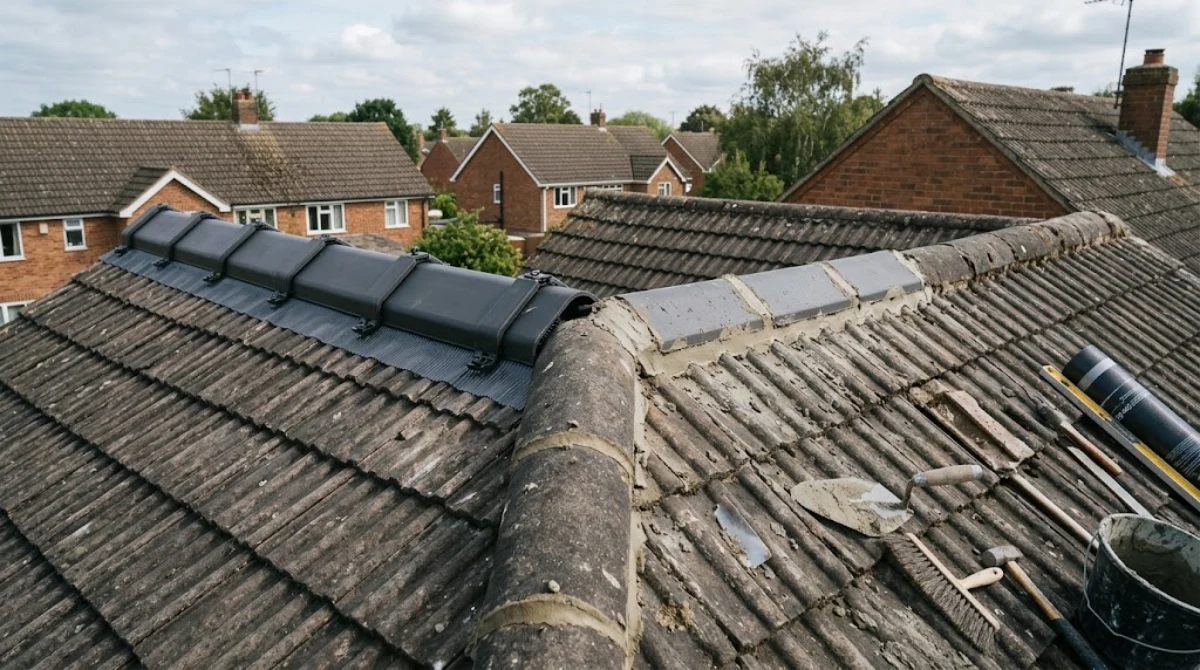
When ridge mortar starts cracking, crumbling, or pulling away from the ridge tiles, homeowners often face a choice: repair the old bedding or move to a dry-fixed system. Dry Ridge vs Mortar Repointing Upgrades matters because the ridge is one of the most exposed parts of a pitched roof, especially across London, Essex, and Hertfordshire Borders.
A quick repoint may look tidy, but it does not always solve loose fixing, ventilation, or repeated weather movement. This guide explains where mortar repointing still fits, when dry ridge is the stronger upgrade, and how A&A Roofing London assesses the right route for tile, slate, and residential roofs.
Quick Check: For a practical roof condition review before choosing dry ridge or mortar work, A&A Roofing London can provide a roof tile material review in London that checks ridge stability, tile condition, and the surrounding roof details.
Dry Ridge vs Mortar Repointing Upgrades Compared
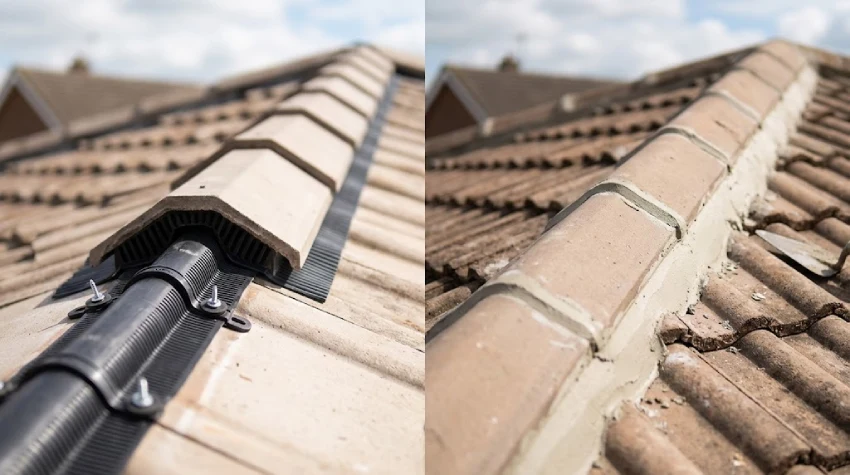
Dry Ridge vs Mortar Repointing Upgrades is not only about appearance. It is mainly about how the ridge tiles are secured, how the roof handles movement, and whether the repair suits the roof’s age, pitch, tiles, and exposure.
BS 8612 covers dry-fixed ridge, hip, and verge systems for slating and tiling, while UK roofing guidance now places strong emphasis on mechanical fixing and correct installation rather than relying on mortar alone.
Ridge upgrade comparison
| Factor | Dry ridge upgrade | Mortar repointing |
| Main fixing method | Mechanical fixings, ridge unions, and a dry ridge roll | Existing mortar joints are renewed or topped up |
| Best suited to | Loose ridge tiles, repeated mortar failure, re-roofing, exposed roofs | Localised cracks where bedding remains sound |
| Ventilation | Many dry ridge systems include high-level ventilation | Mortar does not provide ridge ventilation |
| Maintenance need | Lower ongoing mortar maintenance | Needs periodic inspection and possible future repointing |
| Visual finish | Neat, modern, component-led ridge line | Traditional mortar appearance |
| Key risk if poorly done | Incorrect kit, weak batten fixing, poor roll dressing | Cosmetic pointing over failed bedding |
A&A Roofing London starts by checking whether the ridge tiles are still secure or whether the mortar is simply hiding a deeper fixing problem. Where tile condition is part of the decision, the roof covering itself matters, so a roof tile guide for London homes can help determine whether the ridge upgrade should be treated as a local repair or part of a wider tile roof plan.
For many pitched roofs, the decision also depends on what the surrounding roof is already telling you. Cracked tiles, displaced verge details, worn underlay edges, and slipped ridge sections can all change the answer. A homeowner comparing dry ridge and mortar should also understand the wider tiled roof upkeep routine before treating the ridge as an isolated strip of roof.
Tile Roofing and Ridge Upgrade Decisions
Tile roofing is where Dry Ridge vs Mortar Repointing Upgrades comes up most often. Concrete and clay tiles move slightly with temperature changes, wind pressure, and roof structure movement, so a rigid mortar line can crack over time if the bedding, mix, or surrounding tiles are no longer sound.
Dry ridge is often considered when ridge mortar has failed in several places, when ridge tiles have shifted, or when previous pointing has only lasted a short period. Mortar repointing may still be reasonable where the ridge bedding is stable and the issue is minor surface erosion, but it should not be used as a cosmetic cover for loose tiles.
A&A Roofing London checks the ridge line, tile laps, battens, underlay condition, and nearby cracked tiles before recommending either route. Where the roof covering itself needs attention, the practical next step may involve the tile roof repair process rather than only renewing the ridge joints.
Broken tiles near the ridge can also mislead homeowners. Water may appear to enter near the apex, but the cause may be a cracked tile course below the ridge rather than the ridge bedding itself. That is why the team often checks the broken roof tile assessment steps before deciding whether mortar repointing or dry ridge is the right upgrade.
Slate Roofing and Dry Ridge Compatibility
Slate roofing changes the Dry Ridge vs Mortar Repointing Upgrades conversation because natural slate systems depend heavily on correct laps, fixings, and roof pitch. The ridge must work with the slate layout rather than simply sit above it as a decorative finish.
Dry ridge can be suitable on slate roofs when the system is compatible with the ridge profile and fixing structure. Mortar repointing can still be used in some traditional roof contexts, especially where the roof’s original character matters, but the condition of the existing bedding must be tested first.
For natural slate, A&A Roofing London looks at nail fatigue, slipped slates, ridge alignment, and any lead detailing close to the apex or chimney. If the roof has older slate covering, natural slate roof care should be considered alongside the ridge decision because replacing the ridge without checking the slate field can miss the real weakness.
Where reclaimed slate is involved, the fixing approach becomes even more important. A dry ridge upgrade may solve ridge movement, but only if the pitched roof structure and slate courses below are ready for it. That is why pitched roof checks for reclaimed slate are relevant before upgrading a ridge on older homes.
Flat Roofing Limits in Ridge Comparisons
Flat roofing is not normally the direct setting for Dry Ridge vs Mortar Repointing Upgrades, because ridge tiles belong to pitched roof construction. However, many London properties combine pitched tiled sections with flat roof extensions, dormers, or rear additions, and water problems can be misread when both roof types meet.
A leak near the top floor may not always come from ridge mortar. It can come from a flat roof abutment, upstand, flashing, outlet, or transition point where the flat roof meets the pitched roof. Before ridge work begins, A&A Roofing London checks whether the moisture route actually starts at the ridge or at a different roof form.
This is where roof form checks before material choices help keep the upgrade decision accurate. A dry ridge system solves ridge fixing and ventilation issues; it will not correct a flat roof outlet defect or failed abutment detail.
For mixed roof properties, the comparison should separate symptoms from causes. If mortar looks cracked but water staining tracks from a flat roof junction, ridge repointing may waste money while the true defect remains active.
Pitched Roof Installation and Current Standards
Pitched roof installation is central to Dry Ridge vs Mortar Repointing Upgrades because ridge systems sit at the highest point of the roof structure. The ridge has to resist wind uplift, weather entry, and movement between tile courses.
The Roof Tile Association explains that BS 5534 now requires mechanical fixing of ridge tiles to avoid mortar-related problems and support under-ridge ventilation, while also noting that dry ridge systems should be compatible with the chosen tiles and ridges.
That does not mean every existing roof must be stripped immediately. It does mean that when a ridge is being renewed as part of proper roof work, the fixing method should be considered carefully. Mortar can still appear in some installations, but it should not be treated as the only security for the ridge where modern fixing guidance applies.
A&A Roofing London uses this distinction when inspecting pitched roofs. A small mortar repair is different from a ridge renewal, and a ridge renewal is different from a full re-roof. The team weighs the condition of the roof covering, the exposure of the property, the ridge profile, and whether the homeowner is trying to stop repeated ridge maintenance.
Roof Restoration and Long-Term Ridge Performance
Roof restoration is where Dry Ridge vs Mortar Repointing Upgrades becomes a long-term planning decision. If the roof is already being cleaned, repaired, re-bedded, or restored, it often makes sense to decide whether the ridge should be modernised at the same time.
A dry ridge upgrade can reduce reliance on cement mortar at the apex. It can also add a tidier mechanical fixing method when the rest of the tiled or slate roof is being brought back into serviceable condition. Mortar repointing may still be selected where the ridge is mostly sound and the aim is limited restoration rather than system replacement.
A&A Roofing London treats ridge work as part of roof maintenance in UK planning, not just a visual patch. The ridge, hips, valleys, leadwork, chimneys, gutters, and roof covering all need to be checked together because one weak detail can shorten the life of another.
A practical restoration plan also includes regular inspection. Homeowners can use a roof maintenance damage checklist to spot early movement, cracked bedding, displaced tiles, moss build-up, and storm-related changes before the ridge becomes unsafe.
Ridge work in a restoration plan
| Roof condition | Better first step | Why it matters |
| Minor hairline mortar cracks | Inspect bedding before repointing | Surface cracks do not always mean loose ridge tiles |
| Loose ridge tiles | Lift, assess, and consider dry ridge | Pointing loose tiles is not a secure repair |
| Widespread tile damage | Repair roof covering first | Ridge work cannot compensate for failed tile courses |
| Older slate movement | Check fixings and laps | Ridge upgrade must suit the slate system |
| Chimney or lead defects nearby | Inspect weatherproofing junctions | Leaks may be from leadwork, not ridge mortar |
Roof Repairs: When Repointing Is Not Enough
Roof repairs around the ridge should be approached carefully because Dry Ridge vs Mortar Repointing Upgrades can be mistaken for a simple price comparison. The cheaper-looking repair is not always the right repair if the ridge tiles are loose, the bedding has failed, or the roof has repeated storm movement.
Repointing is mainly a joint repair. It addresses gaps and surface failure in the visible mortar, but it does not automatically renew the bedding below the ridge tile. If the tile can move, rock, or lift, the repair usually needs more than fresh pointing.
Dry ridge becomes more suitable when the homeowner wants a mechanical fixing route and less dependence on mortar. Many dry-fix systems are designed to resist wind loads, reduce water entry, provide ventilation where applicable, and remain durable as a system.
A&A Roofing London checks the repair history as well as the current defect. If ridge mortar has been patched several times, the roof may benefit from dry ridge rather than another short-term pointing job. A wider roof repair warning signs review can also show whether the ridge issue is part of a broader roof failure.
Poor previous work matters too. Over-thick mortar, mismatched mixes, messy pointing, blocked ventilation paths, and ridge tiles set out of line can all affect performance. A homeowner comparing upgrade options should also understand common roofing workmanship defects before approving another mortar repair.
Re-Roofing and Roof Replacement Timing
Re-roofing changes the answer to Dry Ridge vs Mortar Repointing Upgrades because the roof is already being opened, assessed, and rebuilt. At that point, dry ridge is often considered as part of a complete pitched roof specification rather than as an isolated upgrade.
If the tile covering, battens, underlay, and fixings are near the end of service life, repointing the ridge may only delay the larger decision. A dry ridge system installed onto a roof that needs replacement may also be premature unless it forms part of the new roof design.
A&A Roofing London separates local ridge repair from replacement planning. Where the roof covering is still healthy, dry ridge can be a focused upgrade. Where the covering is failing across the roof, the better discussion may be roof repair and replacement differences.
Tile roof replacement work should also consider material compatibility, weight, pitch, exposure, and ridge profile. The tile roof installation sequence helps explain why ridge work belongs at the end of a properly set-out roof system, not as a standalone cosmetic cap.
Lead Work, Chimneys, and Ridge Weatherproofing
Lead work and chimneys often sit close to the same leak zone as ridge tiles, so Dry Ridge vs Mortar Repointing Upgrades should not be decided without checking weatherproofing junctions. Chimney flashings, soakers, back gutters, and lead aprons can all cause water entry that appears to come from the ridge.
A&A Roofing London checks whether the ridge mortar is actually the leak source or whether the visible ridge cracks are only one part of the roof’s weathering problem. This is especially important on older London homes with chimneys, parapets, valleys, and complex roof shapes.
Where weatherproofing details are involved, lead flashing and weatherproofing may be more important than repointing the ridge. Dry ridge can improve apex fixing, but it does not replace correct leadwork around chimneys and abutments.
Storm exposure should also be considered. After high winds, homeowners may notice loose ridge tiles, lifted tiles, or mortar fragments in gutters. A structured storm roof damage checklist helps separate urgent safety issues from planned ridge upgrade work.
Roof Inspections and Maintenance Checks
Roof inspections are the safest way to decide between Dry Ridge and Mortar Repointing Upgrades because ground-level signs rarely show the full condition of the ridge. A crack line may be superficial, or it may indicate failed bedding beneath the ridge tile.
A&A Roofing London inspects ridge alignment, tile movement, bedding condition, mechanical fixing options, ventilation paths, roof pitch, and nearby roof details. The inspection should also consider whether the roof has had repeated pointing, whether mortar is falling out, and whether ridge tiles have shifted after wind.
Homeowners can prepare by reviewing a roof inspection checklist before booking work. This helps identify the visible signs worth reporting, including damp patches, missing mortar, slipped tiles, debris, and roofline changes.
Inspection frequency also matters. A ridge that looked stable several years ago may have changed after frost cycles, storms, or repeated repairs. A practical roof inspection timing guide can help homeowners decide when to check the ridge before damage spreads.
Residential Roofing Across Local Roof Types
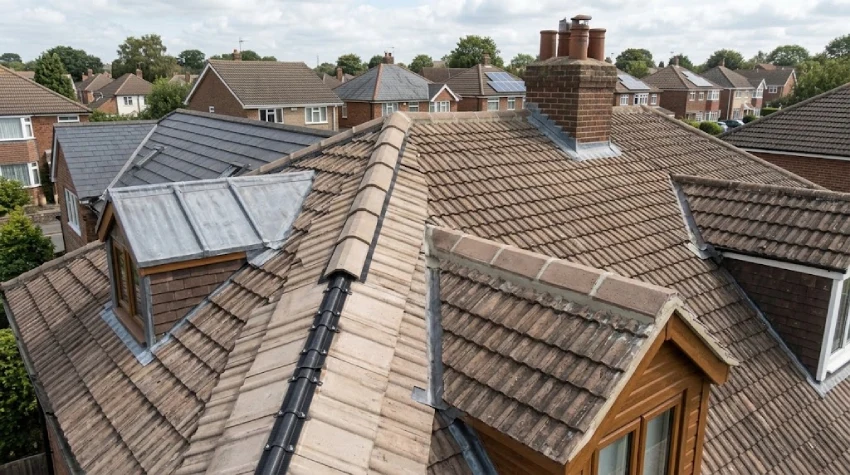
Residential roofing makes Dry Ridge vs Mortar Repointing Upgrades more varied because homes across London, Essex, and Hertfordshire Borders include Victorian terraces, semi-detached homes, modern estates, extensions, and mixed roof forms. The right upgrade depends on the house, not just the ridge material.
Older homes may need more care around slate, chimneys, and traditional details. Newer homes may be better suited to dry-fixed components if the tile profile and roof design match. Extensions may combine flat and pitched roof sections, which can complicate leak tracing.
A&A Roofing London works across these residential roof types by checking the roof as a system. Dry ridge may be the better long-term choice on an exposed pitched tile roof, while mortar repointing may be a proportionate repair on a stable traditional ridge with localised wear.
Property age also affects the decision. A guide to older home roofing factors can help homeowners understand why a ridge repair on a period property may need different judgement from ridge work on a more recent tiled roof.
Dry Ridge vs Mortar Repointing Upgrades Area Coverage
Local roof conditions matter because ridge tiles are exposed to wind, rain, frost, and roof movement. A&A Roofing London serves properties across London, Essex, and Hertfordshire Borders, so the same dry ridge or mortar decision is adapted to the roof type, property age, and surrounding roof details in each area.
North London
North London homes often include pitched tiled roofs, older slate sections, extensions, and chimney details. For Dry Ridge vs Mortar Repointing Upgrades, A&A Roofing London checks whether the ridge issue is linked to ageing mortar, tile movement, chimney weathering, or previous repair work. The aim is to recommend dry ridge where mechanical fixing solves a recurring weakness, and mortar repointing only where the existing ridge remains structurally sound.
Hertfordshire Borders
Across the Hertfordshire Borders, roof types can vary from older residential roofs to more recent tiled properties. A&A Roofing London assesses Dry Ridge vs Mortar Repointing Upgrades by looking at exposure, roof pitch, tile type, and maintenance history. Where ridge mortar has repeatedly cracked or ridge tiles have shifted, a dry ridge upgrade may form part of a broader pitched roof maintenance plan.
Essex
In Essex service areas, A&A Roofing London reviews ridge condition alongside roof covering, lead details, gutters, and storm exposure. Dry Ridge vs Mortar Repointing Upgrades should not be decided from visible mortar cracks alone. The team checks whether the ridge tiles remain firm, whether surrounding tiles are damaged, and whether a dry-fixed system would provide a better long-term route than repeated repointing.
Choosing A&A Roofing London for the Right Ridge Upgrade
A ridge upgrade should solve the actual roof problem, not just make the roofline look neater for a short time. A&A Roofing London checks the ridge, surrounding tiles or slates, pitch, leadwork, ventilation, and repair history before recommending dry ridge or mortar repointing. For homeowners comparing Dry Ridge vs Mortar Repointing Upgrades, the best starting point is a practical roof tile material review in London that identifies whether the ridge needs a local repair, a dry-fixed upgrade, or wider roof restoration.
FAQs About Dry Ridge vs Mortar Repointing Upgrades
What is the main difference between Dry Ridge vs Mortar Repointing Upgrades?
The main difference is the fixing method. A dry ridge system uses mechanical fixings and dry ridge components to secure the ridge tiles, while mortar repointing renews or repairs the visible mortar joints. In Dry Ridge vs Mortar Repointing Upgrades, dry ridge is usually considered when the ridge needs a more durable fixing route, while repointing is more limited and depends on the existing bedding still being sound.
Is mortar repointing still acceptable for ridge tiles?
Mortar repointing can still be acceptable where the ridge tiles are stable, the bedding has not failed, and the damage is limited to minor surface deterioration. However, Dry Ridge vs Mortar Repointing Upgrades should not be reduced to appearance. If the ridge tile moves, the bedding is loose, or mortar has failed repeatedly, repointing may only cover the problem rather than restore secure fixing.
Does a dry ridge system stop all roof leaks?
A dry ridge system can improve ridge fixing, weather resistance at the apex, and ventilation where the system provides it, but it does not stop every roof leak. In Dry Ridge vs Mortar Repointing Upgrades, A&A Roofing London also checks tiles, slates, leadwork, chimneys, valleys, flat roof junctions, and underlay edges because water can travel from several roof details before appearing indoors.
When should I choose dry ridge instead of repointing?
Dry ridge is often the better option when ridge tiles are loose, mortar has cracked repeatedly, the roof is exposed to wind, or the ridge is being renewed as part of wider roof work. In Dry Ridge vs Mortar Repointing Upgrades, the choice should be based on fixing security, roof condition, and compatibility with the existing tile or slate system rather than on surface cracks alone.
Can dry ridge be fitted to an older roof?
Dry ridge can often be fitted to older roofs, but the roof must be checked first. In Dry Ridge vs Mortar Repointing Upgrades, older roofs need careful assessment of tile or slate condition, ridge profile, battens, roof pitch, chimneys, and leadwork. If the surrounding roof covering is weak, A&A Roofing London may recommend repairs or restoration before fitting a dry ridge system.
Why does ridge mortar crack on UK roofs?
Ridge mortar can crack because of weather exposure, frost, roof movement, poor mix, age, wind pressure, or previous weak workmanship. In Dry Ridge vs Mortar Repointing Upgrades, cracked mortar is treated as a symptom that needs investigation. The important question is whether the ridge tiles remain secure or whether the bedding and fixing method have failed beneath the visible joint.
How often should ridge tiles be inspected?
Ridge tiles should be inspected as part of routine roof maintenance and after significant storms or visible roof changes. In Dry Ridge vs Mortar Repointing Upgrades, inspection frequency depends on the property age, roof exposure, repair history, and tile type. Homeowners should look for missing mortar, loose fragments, shifted ridge tiles, damp patches, and cracked tiles, then arrange a closer roof inspection where signs appear.