
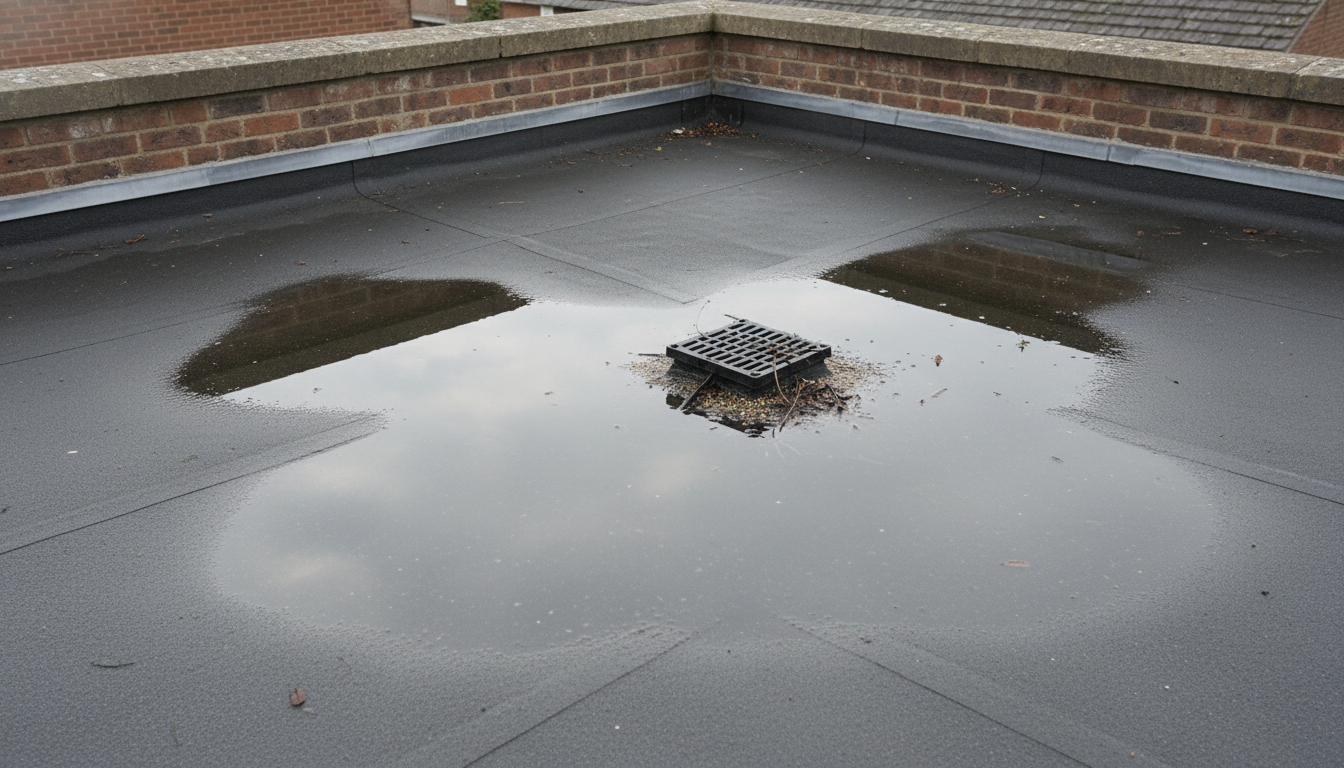
Roof Drainage Problems UK: How Poor Water Flow Causes Damage starts with one simple failure: rainwater stops leaving the roof cleanly. Once gutters, valleys, outlets, flashings, flat roof falls, or downpipes slow down, water can back up under tiles, soak roof edges, overload flat roofs, stain walls, and reach hidden timbers before the leak looks serious indoors.
A & A Roofing London helps homeowners across London, Essex, and the Hertfordshire borders inspect poor water flow, trace the route of roof leaks, and choose the right maintenance, repair, restoration, or replacement route.
Quick Check: If water is overflowing, ponding, or tracking back into the roof, arrange a roof inspection in the UK with A & A Roofing London before poor drainage spreads hidden damage.
Roof Drainage Problems UK: How Poor Water Flow Causes Damage
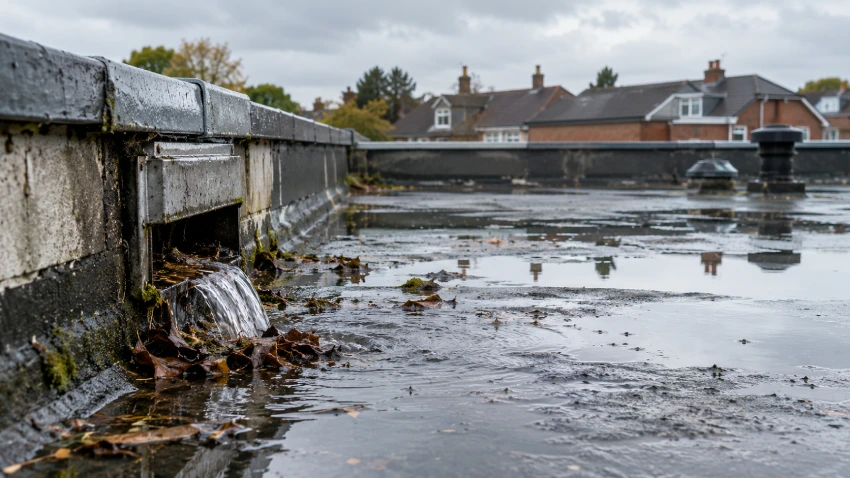
Roof Drainage Problems UK: How Poor Water Flow Causes Damage is about the full rainwater path, not just gutters. Planning Portal defines roof drainage as the above-ground system of gutters and rainwater pipes, while underground pipework is treated as surface water drains and sewers. That distinction matters because roof damage often starts before water ever reaches the ground drainage system.
| Drainage point | What can go wrong | Damage risk | A & A Roofing London check |
| Gutters | Blockage, sagging, poor fall, overflow | Soaked fascias, damp walls, roof-edge rot | Flow direction, fixings, outlets, debris |
| Valleys | Leaves, moss, tile grit, poor lining | Water pushed beneath tiles or slates | Valley channel, cuts, lining, outlet path |
| Flat roofs | Ponding, blocked outlets, weak falls | Cracks, blisters, deck moisture, leaks | Surface fall, membrane, deck, discharge |
| Flashings | Water backing behind junctions | Chimney leaks, wall damp, hidden ingress | Leadwork, laps, chases, upstands |
| Downpipes | Blocked or undersized discharge | Overflow and repeated water loading | Pipe route, capacity, connection points |
Roof drainage problems need early inspection because water rarely stays where it first overflows. It follows laps, battens, underlay, rafters, wall junctions, insulation, and ceiling lines. The stain inside the property may be several feet from the blocked gutter, valley, or outlet that started the problem.
A & A Roofing London inspects the drainage route as a system: roof pitch, covering, gutters, outlets, valleys, flat roof surfaces, flashings, chimneys, and internal signs. That avoids the common mistake of clearing a gutter while leaving a failed valley, flat roof outlet, or flashing junction untreated.
Tile Roofing and Poor Water Flow
Tile roofing depends on rainwater shedding down the slope without being driven sideways under the covering. When gutters overflow or valleys block, water can collect near tile edges and move beneath laps that were designed to shed flowing water, not hold backed-up water.
A & A Roofing London checks whether tile roofing in London is being affected by blocked valleys, displaced tiles, poor gutter alignment, or debris washing down from the roof surface. A tile roof may look sound from ground level while water is repeatedly entering at one restricted drainage point.
Where valley debris is part of the problem, valley blockage flow sequence helps explain how leaves, moss, and roof grit slow the channel. If the issue is repeated leaking rather than simple blockage, roof valley leak mechanics is the more useful next check.
Slate Roofing and Drainage Pressure
Slate roofs rely on precise laps, alignment, and fixing. Poor drainage can cause water to sit where it should not, especially near valleys, gutters, abutments, and chimney junctions. Once water backs up beneath slate courses, a small drainage problem can become a hidden leak.
A & A Roofing London checks slate roof maintenance in the UK alongside the water route. The inspection looks at slate edges, slipped pieces, gutters, valleys, underlay condition, and any damp signs in the loft or top-floor ceilings.
Slate drainage issues are often mistaken for general roof age. The practical test is whether water is entering through failed slates or whether the drainage path is forcing water into weak junctions. That is why inspection should include valleys, gutters, leadwork, and roof slope condition together.
Flat Roofs and Ponding Water
Flat roofs are especially sensitive to poor water flow because they have limited pitch. Water should move toward outlets or edges without sitting for long periods. When ponding develops, the surface stays wet, membranes age faster, and cracks or blisters can become leak routes.
A & A Roofing London checks flat roofs in London for outlet blockage, poor falls, blistering, cracks, open laps, weak trims, and deck softness. The team also checks whether water from a pitched roof above is discharging onto the flat roof too heavily.
Flat roof drainage should never be judged only by whether water is visible after rain. The important questions are where the water gathers, how long it remains, whether the surface is splitting, and whether the outlet can cope. For linked symptoms, flat roof blister-and-crack progression is a relevant supporting guide.
Pitched Roof Maintenance and Water Direction
Pitched roof maintenance should include water direction. Roof pitch, tile or slate alignment, valleys, gutters, ridges, flashings, and eaves details all influence how quickly water leaves the roof.
A & A Roofing London checks pitched roof maintenance in the UK by looking at the roof as a water-shedding system. The goal is to find where rainwater slows, overshoots, backs up, or enters behind the covering.
Poor water flow can appear after storms, seasonal debris, roof movement, or previous repair work. If a drainage fault appeared after bad weather, storm roof observation framework helps homeowners record visible signs safely before a roof inspection.
Roof Restoration and Drainage Correction
Roof restoration should never ignore drainage. A roof can be cleaned, coated, repointed, or cosmetically improved and still fail if gutters, valleys, outlets, or flashings keep sending water into the wrong places.
A & A Roofing London links roof damage in the UK with drainage performance before recommending restoration. If the covering is still sound but water flow is poor, restoration may include clearing debris, correcting gutters, repairing valleys, checking flashings, and replacing damaged roof components.
NFRC states that moss on roof tiles is rarely a problem in most cases and usually only needs removing where it blocks gutters, outlets, or other drainage points on the roof. NFRC also warns that inappropriate moss-removal methods can damage roof coverings. For drainage-led restoration, moss-related blockage conditions and roof moss removal cautions are both useful next references.
Roof Repairs for Poor Water Flow
Roof repairs should start with the cause of the water movement, not only the internal stain. A ceiling leak below a valley, chimney, flat roof, or gutter may be the final symptom of drainage failure elsewhere.
A & A Roofing London traces how water travels from the roof surface to the visible damage. That may involve checking gutters, downpipes, valley channels, tile cuts, slate edges, flashing laps, flat roof outlets, and damp marks inside the loft.
| Symptom | Possible drainage cause | What should be inspected |
| Water spills over gutter edge | Blocked outlet or wrong gutter fall | Gutter line, downpipe, debris, brackets |
| Damp near chimney breast | Water backing behind leadwork | Flashing, stack, valley, roof covering |
| Leak below flat roof | Ponding or outlet restriction | Membrane, outlet, deck, edges |
| Stains near roof edge | Overflow soaking fascia or eaves | Gutter, soffit, underlay, tile edge |
| Recurring leak after rain | Hidden water path not corrected | Full drainage route and internal track |
For the symptom side, roof leak pathway categories helps explain why the visible stain may not sit below the source. If a homeowner is deciding whether the roof needs a small correction or wider work, repair scope decision steps are a better reference than guessing from one wet patch.
Re-Roofing and Replacement After Drainage Failure
Roof Drainage Problems Uk How Poor Water Flow Causes Damage can eventually move from repair into replacement. This happens when repeated overflow has damaged underlay, battens, decking, insulation, fascias, soffits, or the roof covering itself.
Planning Portal states that most roof replacement work on existing buildings needs Building Regulations approval. It also notes that if the roof covering is changed to a different material, approval may be needed to check structural stability, fire safety, and energy efficiency. Because a roof is a thermal element, re-covering work should also include improving thermal insulation properties.
A & A Roofing London checks whether the roof can be repaired, restored, or should be replaced because the drainage failure has spread too far. Where a homeowner is unsure whether the problem is still local, roof repair warning patterns and roof replacement timing factors give useful context.
Lead Work, Chimneys, and Water Back-Up
Lead work and chimneys are common places for drainage problems to become leaks. Water that should move down a slope can back up against a chimney stack, abutment, or wall junction. If the flashing is weak, shallow, cracked, or poorly lapped, water can enter behind it.
A & A Roofing London checks leadwork, soakers, cover flashings, chimney masonry, pointing, valleys, gutters, and nearby roof coverings together. This matters because drainage failure and flashing failure often overlap.
For junction-led drainage issues, flashing water-deflection basics helps explain why transitions are vulnerable. Where leadwork is central to the leak route, leadwork junction principles is a useful next read. If the stain appears near a stack, chimney moisture tracing points should be considered too.
Gutters, Downpipes, and Roof Edges
Gutters are often blamed for roof drainage problems, but the real issue may be how the roof edge, gutter line, outlet, downpipe, valley discharge, and fascia work together. A clean gutter can still overflow if it has poor fall, weak brackets, undersized outlets, or heavy water discharge from valleys.
A & A Roofing London checks whether the gutter receives water properly from the roof covering and whether it moves water away fast enough. Overflow near roof edges can soak fascias, soffits, brickwork, and roof timbers.
The most direct supporting topic is gutter overflow damage pattern. This is especially relevant where homeowners see water spilling over the gutter during rain even after recent cleaning.
Inspections and Maintenance for Drainage
Roof drainage maintenance should be regular because debris builds gradually. Leaves, moss, grit, loose mortar, cracked tile fragments, and storm debris can all slow water flow before there is a visible leak.
A & A Roofing London checks roof drainage during planned inspections by reviewing gutters, outlets, valley channels, roof edges, flat roof falls, leadwork, chimney junctions, and any internal damp evidence. The aim is to prevent poor water flow from becoming a hidden structural issue.
HSE roof-work guidance says all roofs should be treated as fragile until a competent person confirms otherwise, and roof work requires suitable precautions. This matters because drainage defects often tempt homeowners to climb up and clear gutters, valleys, or flat roof outlets without safe access. For safer planning, roof inspection interval guidance, roof inspection item map, and seasonal maintenance task order are useful.
Storms, Weather, and Drainage Load
Poor water flow often appears after heavy weather because rain, wind, frost, and debris increase the load on valleys, gutters, outlets, and flashings. A roof that copes during light rain may overflow when wind-driven rain and debris hit at the same time.
A & A Roofing London checks whether a storm caused the drainage issue or simply exposed a weakness that already existed. That distinction affects whether the roof needs urgent weatherproofing, targeted repair, cleaning, restoration, or replacement.
For homeowners checking from a safe position, weather pressure roof patterns helps connect weather exposure with water-flow failure. If water is already entering the property, emergency water-entry response gives a safer first-response route.
Residential Roofing and Mixed Drainage Paths
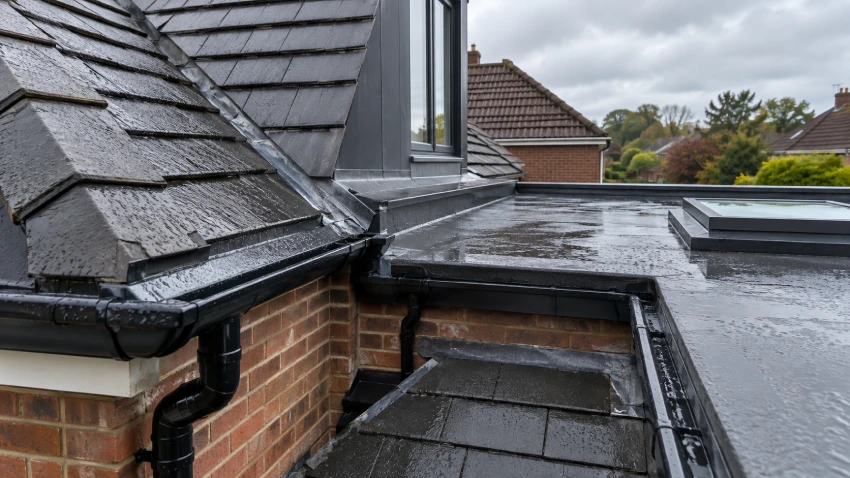
Residential roofing often combines pitched roofs, flat roof extensions, chimneys, parapets, valleys, gutters, dormers, and rooflights. That makes roof drainage problems harder to diagnose because water may travel across more than one roof type before it reaches the leak point.
A & A Roofing London checks the whole water route rather than inspecting one component in isolation. A flat roof leak may start at a pitched roof valley above. A chimney stain may begin with gutter overflow. A damp wall may be caused by downpipe discharge, roof-edge overshoot, or failed flashing.
Flat roofs are especially important in mixed layouts. Where an extension or dormer is involved, flat roof restoration suitability factors and flat roof ageing markers can help homeowners understand whether drainage failure is part of wider surface decline.
Roof Drainage Problems Uk How Poor Water Flow Causes Damage Area Coverage
Local roof layout, access, surrounding trees, roof age, and mixed roof designs all affect how drainage problems develop. A & A Roofing London covers North London, Essex, and the Hertfordshire borders, helping homeowners inspect gutters, valleys, flat roofs, chimneys, leadwork, and internal damp signs before poor water flow spreads.
North London
In North London, Roof Drainage Problems Uk How Poor Water Flow Causes Damage often involves terraced homes, flat roof extensions, dormers, valleys, chimneys, and tight access around gutters. A & A Roofing London can trace whether water is backing up from valleys, overflowing from gutters, ponding on flat roofs, or entering around leadwork.
Hertfordshire Borders
Across the Hertfordshire borders, Roof Drainage Problems Uk How Poor Water Flow Causes Damage may involve tiled roofs, slate roofs, older gutter runs, nearby trees, and roof junctions that collect debris. A & A Roofing London checks the full drainage route so homeowners know whether the right answer is maintenance, repair, restoration, or replacement.
Essex
In Essex, Roof Drainage Problems Uk How Poor Water Flow Causes Damage can become visible after heavy rain, wind-blown debris, moss movement, or repeated overflow at roof edges. A & A Roofing London can inspect flat roofs, pitched roofs, gutters, outlets, valleys, flashings, and internal damp signs to identify the source of poor water flow.
Final Roofing Decision
Roof Drainage Problems Uk How Poor Water Flow Causes Damage should be addressed before water reaches hidden roof layers. A blocked gutter, valley restriction, flat roof ponding area, or flashing back-up can move moisture into timbers, insulation, walls, ceilings, and roof edges.
A & A Roofing London can carry out a roof inspection in the UK to check the full drainage route: tiles, slates, flat roofs, pitched roofs, gutters, downpipes, valleys, outlets, leadwork, chimneys, and internal leak evidence. The right outcome may be clearance, maintenance, targeted repair, restoration, or replacement. The key is to restore water flow before the roof starts failing around it.
FAQs About Roof Drainage Problems Uk How Poor Water Flow Causes Damage
What are the most common Roof Drainage Problems Uk How Poor Water Flow Causes Damage?
The most common drainage problems are blocked gutters, blocked valleys, ponding flat roofs, poor gutter fall, restricted outlets, weak downpipes, and water backing up around flashings or chimneys. Planning Portal defines roof drainage as the above-ground system of gutters and rainwater pipes, but homeowners should also think about valleys, outlets, roof edges, and flat roof falls because all of these direct rainwater before it reaches the downpipe.
How does poor roof drainage cause internal leaks?
Poor roof drainage causes internal leaks when water is held at roof edges, valleys, flat roof seams, flashings, or outlets instead of being carried away. Water then follows the easiest route beneath tiles, slates, underlay, battens, insulation, masonry, or decking. The ceiling stain may not sit directly below the blockage because water can travel along roof layers before it drips inside. A & A Roofing London traces that route before recommending repair.
Can blocked gutters damage the roof itself?
Yes. Blocked gutters can damage the roof because overflowing water can soak fascias, soffits, roof edges, brickwork, and nearby timbers. If the water backs up under the roof covering, it can also affect underlay, battens, insulation, and internal finishes. A gutter issue should therefore be checked with the roof edge, outlet, downpipe, and any valley that discharges into that gutter, not treated as a separate cosmetic problem.
Do flat roofs suffer more from poor drainage?
Flat roofs are especially vulnerable because they rely on shallow falls, outlets, edges, and waterproofing details. If water ponds, the membrane stays wet longer and cracks, blisters, open seams, or weak trims become more serious. A & A Roofing London checks flat roof surfaces, outlets, deck condition, insulation risk, and water discharge from higher pitched roofs before deciding whether the problem needs repair, restoration, or replacement.
Should moss be removed to prevent drainage problems?
Moss should be dealt with when it blocks gutters, outlets, valleys, or other roof drainage points. NFRC says moss on roof tiles is rarely a problem in most cases and usually only needs removal where it is blocking gutters, outlets, or other drainage points on the roof. NFRC also warns that damaging removal methods can create more roof problems than the moss itself.
Is it safe for homeowners to clear roof drainage blockages?
Homeowners should be cautious. Ground-level observations are sensible, but climbing to clear gutters, valleys, flat roof outlets, or roof edges can be dangerous. HSE states that all roofs should be treated as fragile until a competent person confirms otherwise, and roof work requires careful planning and suitable precautions. A safer route is to photograph visible overflow, note when it occurs, and arrange a proper roof inspection.
When do drainage problems mean the roof needs replacing?
Drainage problems may point to replacement when water has caused widespread underlay damage, rotten decking, recurring leaks, saturated insulation, failed flat roof membranes, or repeated overflow that cannot be corrected by maintenance. Planning Portal states that most roof replacement work on existing buildings needs Building Regulations approval, and re-covering a roof should include improving thermal insulation because a roof is a thermal element.
What should A & A Roofing London inspect first?
A & A Roofing London should inspect the full water route first: where rain lands, where it travels, where it slows, and where it exits. That includes roof pitch, tiles, slates, valleys, gutters, outlets, downpipes, flat roof falls, flashings, chimneys, and internal damp signs. This prevents the repair from focusing only on the visible stain while the real drainage restriction remains active.