
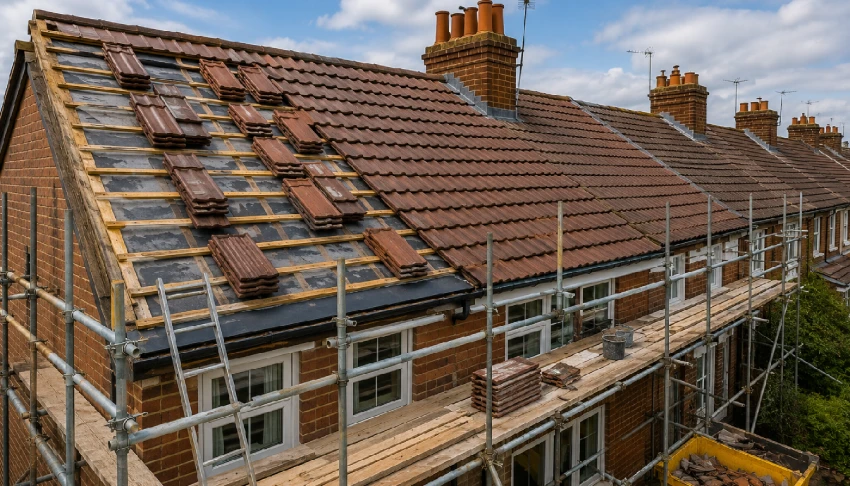
Roof restoration prices in the UK feel confusing because two quotes rarely include the same work. One roofer may price cleaning and coating, while another includes scaffolding, felt, battens, leadwork, waste removal, timber repairs, and VAT. A serious cost check starts by comparing scope before price, then matching the right repair level to the actual roof condition.
Roof Restoration Costs Explained UK

The roof restoration cost is not one fixed number. It depends on Key Roof Restoration Costs, Restoration vs. Replacement, and Factors Influencing Costs and Common Repair Costs. The right price only makes sense when the roof type, access, materials, damage, and hidden risks are clearly written down.
Cost Area | Lower-Cost Case | Higher-Cost Case | What to Check |
Small repair | A few broken tiles or a minor leak | Several leak points | Is the source confirmed? |
Roof cleaning | Light moss, easy access | Heavy moss, fragile tiles | Is safe cleaning included? |
Ridge or verge work | Local repointing | Dry ridge or wider re-bedding | Is the fixing method clear? |
Flat roof work | Local patch or coating | Wet deck or full overlay | Is the deck dry? |
Scaffold | Small front elevation | Full access around the property | Is the removal date agreed? |
Timber repairs | Minor batten change | Rafter ends or rotten deck | Is hidden work priced? |
Replacement | Simple roof shape | London terrace, access issues | Is VAT and waste included? |
A roof restoration quote should not only say “repair roof” or “seal roof.” It should show materials, access, labour, waste removal, roof area, warranty, exclusions, and hidden damage rules. Without these details, the lowest price can become the most expensive choice.
Step 1: Separate Repair, Restore and Replace
Many homeowners receive a high roof quote and do not know what they are actually buying. A small repair, a roof restoration, a partial re-roof, and a full replacement are very different jobs. The cost changes because the risk, access, labour, and materials change.
A minor roof repair usually deals with one clear defect. This may include replacing broken tiles, fixing a small leak, reseating a slipped slate, or repairing a small flashing gap. It costs less because the wider roof structure is still sound.
A roof restoration is wider than a small repair. It may include cleaning, moss treatment, ridge work, tile replacement, flashing repair, gutter correction, and local waterproofing. It is useful when the roof is worn but not structurally failed.
A partial re-roof means a section is opened and rebuilt. This may happen when felt, battens, or a flat roof membrane has failed in one area. It costs more because materials must be lifted, replaced, and detailed properly.
A full roof replacement is needed when the covering, felt, battens, timber, or roof system has failed widely. It usually includes stripping, new underlay, new battens, tiles or slate, leadwork, waste removal, and scaffold. This is why “doing the felt” can sometimes become much more than a small repair.
Step 2: Check Key Roof Restoration Costs
The main cost areas should be clear before work begins. If a quote hides them in one total price, it becomes hard to compare. A professional quote should explain each cost layer in plain language.
Key Roof Restoration Costs often include:
- Roof inspection and diagnosis
- Moss removal and cleaning
- Broken tile or slate replacement
- Ridge, hip, or verge repairs
- Lead flashing and chimney details
- Flat roof patching or overlay
- Gutter and drainage correction
- Scaffolding or access equipment
- Waste removal and site cleanup
- Hidden timber or batten repairs
A small repair may only involve labour, access, and a few materials. A larger restoration may include several trades, specialist systems, and safer access. A full replacement includes removal, rebuild, disposal, and a longer schedule.
For damaged clay or concrete roof coverings, tile roof installation in london may become relevant when repairs no longer make sense. This link fits best where tile failure, cracked tiles, or repeated tile repairs are discussed. It should not be forced into a flat roof cost section.
Step 3: Understand Factors Influencing Costs
Roof restoration cost depends on what the roofer must physically handle. Roof size, pitch, access, material, location, and damage level all affect the final price. A quote without these details is not useful for a fair comparison.
The first factor is roof size and shape. A small straight roof is easier to price than a roof with valleys, chimneys, dormers, rooflights, parapets, and awkward junctions. Complex shapes take longer because every detail needs careful waterproofing.
The second factor is roof pitch and height. Steeper roofs slow the work and increase safety needs. High roofs, terraces, and restricted access can also increase scaffold or access costs.
The third factor is roof material. Concrete tiles, clay tiles, natural slate, felt, EPDM, GRP, and liquid membranes all have different labour and material costs. Matching old tiles or slate can cost more than using standard modern materials.
The fourth factor is location. London and the South East often carry higher labour, access, parking, disposal, and scaffold costs. This is why a price that sounds high nationally may still be normal for a London terrace.
For older slate roofs, slate roofing service in london belongs near the material-cost discussion. Natural slate often needs skilled handling, careful matching, and precise fixing. This makes the cost structure different from basic tile replacement.
Step 4: Common Repair Costs That Add Up
Common Repair Costs may look small when viewed alone. The problem appears when several small items are needed at the same time. Broken tiles, flashing, ridge work, gutters, and access can quickly push a simple job into a restoration project.
Common Repair Area | Why It Adds Cost | Cost Risk |
Broken tiles | Matching and safe access | A scaffold may cost more than tile |
Lead flashing | Skilled detail work | Poor flashing causes repeat leaks |
Ridge tiles | Mortar or dry fix method | Cheap patching may fail |
Gutters | Drainage affects roof edges | Blocked water can rot felt |
Felt and battens | Tiles must be lifted | Can become a partial re-roof |
Flat roof coating | Prep decides success | A wet deck can ruin the coating |
Chimney work | High access and detail | A scaffold may be required |
A homeowner may think only one tile is broken. The roofer may find weak battens, failed felt, or rotten timber once access is set up. This is why hidden repair pricing should be agreed before work begins.
For homes with ageing roof sections, roof restoration services uk should be positioned where the page explains wider restoration instead of repeated patching. This anchor is strongest after discussing multiple repair points. It helps move readers from price confusion to a proper assessment.
Step 5: Scaffolding and Access Change Prices
Scaffolding is one of the biggest reasons roof quotes vary. Some small jobs may use ladders or towers, but many roof works need safer access. A quote that excludes scaffold may look cheaper but may not be realistic.
Terraced homes can be harder to access than detached houses. Rear roofs, narrow alleys, extensions, conservatories, and pavement restrictions can all increase setup cost. London properties often face extra access and parking challenges.
The scaffold quote should confirm the setup area, hire period, removal date, and permit needs. It should also say whether edge protection, chimney access, or rear elevation access is included. Homeowners should avoid vague quotes that mention scaffold without detail.
A useful payment approach is to keep final payment tied to completion standards. Some homeowners also ask for scaffold removal timing before signing. This avoids the common problem of scaffold staying longer than expected.
Step 6: Hidden Timber and Felt Cost Risks

Hidden roof costs often appear after the covering is lifted. A roof can look repairable from outside but hide rotten battens, weak felt, damp rafter ends, or decayed soffit areas. These issues can change the quote quickly.
Felt and battens are major cost triggers. If the felt has failed widely, tiles may need to come off across a larger area. At that point, restoration can move closer to partial re-roofing.
Rotten timber is another common risk. Rafter ends, joists, decking boards, fascia, soffits, and roof edges can decay after long-term leaks. The quote should state how these repairs are charged.
Ask for a written variation rule. This can be priced per metre, per board, per rafter end, or by agreed inspection before continuing. This protects the homeowner from surprise costs after the roof is opened.
For flat roof problems, flat roof replacement london should sit where wet decking, failed felt, or repeated leaks are discussed. A flat roof with rotten deck or soaked insulation usually needs more than coating. The anchor supports a stronger conversion path from cost-risk discussion to service action.
Step 7: Restoration vs. Replacement
Restoration vs. Replacement is the key money question. Restoration is cheaper only when the roof structure is still sound. Replacement is often cheaper long term when the roof is failing widely.
Choose restoration when defects are localised. This may include minor tile replacement, light ridge repair, flashing correction, moss removal, and isolated flat roof patching. It works best when the roof has no widespread structural failure.
Choose replacement when the same problems keep returning. Repeated leaks, soft decking, rotten timbers, saturated insulation, failed felt, widespread cracked tiles, and structural sagging all point toward replacement. Paying for another patch can delay the same larger bill.
There is also a middle route. Some roofs need a partial re-roof where one slope, one flat roof section, or one problem area is rebuilt. This can save money when the rest of the roof is still healthy.
If the main roof needs rebuilding rather than surface restoration, pitched roof installation solutions uk fits naturally in this section. The anchor should appear when replacement becomes the safer long-term choice. It guides readers who realise restoration may not be enough.
Step 8: Compare Quotes Without Getting Caught
The safest way to compare roof prices is to compare like for like. A quote with scaffold, VAT, waste removal, leadwork, hidden timber rules, and clear materials may look higher but be more complete. A cheaper quote may exclude the items that later become expensive.
Ask each roofer for photos of the problem areas. Photos help show whether the issue is broken tiles, failed felt, leadwork, guttering, ridge mortar, flat roof cracks, or timber decay. They also help you get a second opinion.
For major bills, a surveyor or drone inspection can be useful. This is especially true when one roofer recommends full replacement and another suggests repair. An unbiased view can stop unnecessary spending.
Look for red flags before agreeing:
- No written scope
- No scaffold details
- No VAT clarity
- No product names
- No photos
- No waste removal terms
- No warranty terms
- No hidden repair process
- Pressure to start immediately
- Large extras after the scaffold goes up
For general inspection and project guidance, professional roofing solutions in London should be used once in this quote-checking section. This placement fits because readers are deciding who to trust. It turns cost education into a service enquiry without sounding forced.
Step 9: Final Cost Decision Checklist
Before accepting a roof restoration quote, check the condition, scope, and risk. A roof price is only meaningful when the work is fully understood. The checklist below keeps the decision practical.
Condition checklist:
- Are leaks traced to the real source?
- Is the roof structure sound?
- Are felt and battens checked?
- Are tiles or slates reusable?
- Are flashings inspected?
- Are gutters draining properly?
- Is flat roof ponding explained?
- Is hidden timber risk covered?
Quote checklist:
- Is the roof area stated?
- Is access included?
- Is a scaffold included?
- Is VAT included?
- Is waste removal included?
- Are materials named?
- Are exclusions written?
- Is the warranty clear?
- Is payment on completion defined?
Decision checklist:
- Repair if the issue is small and clear.
- Restore if the roof is sound but worn.
- Partially re-roof if one section has failed.
- Replace if the roof has widespread structural failure.
- Get another quote if the explanation is vague.
For material comparison before choosing a roof covering, use the guide on common roof tile types UK. This link belongs near tile or slate cost decisions. It helps readers understand why one material choice may cost more than another.
For flat roof owners, the flat roof restoration guide is useful when the problem involves felt, EPDM, GRP, ponding, or waterproofing. This link should appear only once because it supports a specific flat roof cost path. It prevents the page from mixing flat roof and pitched roof advice too heavily.
A homeowner planning budget timing can also review flat roof lifespan UK. This works near the final decision stage because lifespan affects whether repair or replacement is worth it. It helps users judge whether short-term repair is sensible.
Frequently Asked Questions
How much does roof restoration cost in the UK?
Roof restoration can range from small repair costs to several thousand pounds depending on the roof. Cleaning, tile replacement, ridge repairs, scaffold, leadwork, and hidden timber all change the price. The most accurate answer comes from a written scope, not a rough average.
Is £13k normal for a roof in London?
It can be normal for a London terrace if the quote includes scaffold, felt, battens, tiles, labour, waste, VAT, and some timber work. It may be expensive if it only covers limited repair work. The scope decides whether the price is fair.
Does scaffolding come inside the roof restoration cost?
Sometimes it does, and sometimes it is listed separately. Always ask whether scaffold supply, hire period, removal, pavement permits, and rear access are included. Missing scaffold details can make a cheap quote misleading.
Can roof restoration avoid full replacement?
Yes, when the roof structure is sound and the defects are localised. Broken tiles, flashing problems, moss, gutters, and limited ridge work may be restored without a full replacement. Widespread felt, batten, timber, or deck failure changes the decision.
What hidden costs appear after roof work starts?
Hidden costs often include rotten battens, damaged felt, weak rafter ends, wet insulation, cracked leadwork, broken tiles, fascia decay, and drainage faults. These can appear once coverings are lifted. Ask for written rates or approval rules before work starts.